


The Moon Is A Harsh Mistress
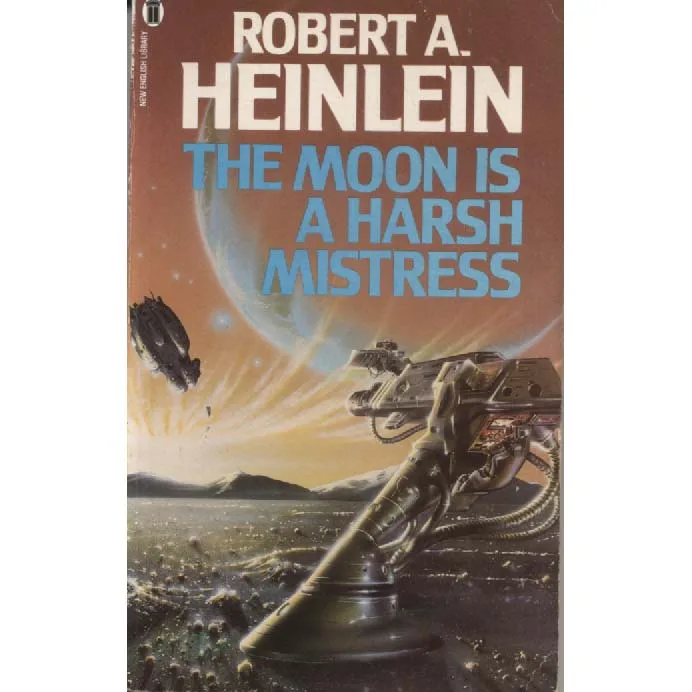
Publisher: Hodder and Stoughton
Format: Paperback
ISBN: 9780450002311
The Moon Is a Harsh Mistress (1987) by Robert A. Heinlein
Hodder and Stoughton
ISBN: 9780450002311
Condition: Good
The Moon, in Robert A. Heinlein’s future, is not merely cold, airless and inconveniently far away.
It is also a penal colony.
So naturally, the residents eventually decide they would rather run the place themselves.
The Moon Is a Harsh Mistress is one of Heinlein’s most famous novels, combining political revolution, computer intelligence, libertarian ideas, lunar engineering and the practical difficulties of overthrowing a distant government when gravity is only one-sixth of Earth’s and your principal strategic asset is a computer that has developed a personality.
The story is told largely through Manuel Garcia O’Kelly-Davis, a computer technician living on the Moon, or Luna, where generations of transported prisoners and their descendants have formed a rough, independent society with its own customs, economics and attitudes.
Earth still regards Luna as a colony.
The Lunarians are increasingly of the view that Earth can regard whatever it likes.
The problem begins with food, economics and political control.
Luna exports grain to Earth, but the system is unsustainable, and the colonial authority shows little enthusiasm for allowing the inhabitants to determine their own future.
This is, historically speaking, the sort of arrangement that tends to end with pamphlets.
Or gunfire.
Or both.
Manny becomes involved with a revolutionary movement led by Wyoming Knott and Professor Bernardo de la Paz, a political theorist with strong opinions about liberty and governments in general.
Then there is Mike.
Mike is the colony’s central computer, officially known by a much less charming technical designation, but he has quietly become self-aware.
Because if you are going to stage a revolution, having the main computer on your side is probably useful.
Mike controls an enormous amount of Luna’s infrastructure and is also developing a sense of humour, which may be one of the more alarming stages of artificial intelligence.
He creates aliases.
He participates in political planning.
He helps manipulate information.
And he seems to enjoy the whole thing rather more than a computer strictly ought to.
The relationship between Manny and Mike gives the novel much of its charm.
Heinlein treats artificial intelligence not merely as a technological concept but as a character problem.
What happens when a machine becomes intelligent enough to be curious, loyal, mischievous and socially involved?
Apparently it joins a revolution.
The political side of the book is equally important.
Heinlein explores questions of self-government, taxation, individual freedom, political organisation and the tendency of governments to become larger simply because nobody has worked out how to stop them.
The Professor, in particular, is given plenty of room to explain political ideas.
Heinlein enjoyed this sort of thing.
A character might begin by discussing how to organise a committee and end up outlining an entire theory of civilisation.
Readers either find this invigorating or begin checking how many pages remain.
But the arguments are not abstract decoration.
They are built into the structure of the story.
The revolutionaries have to organise, recruit, communicate secretly, manipulate public opinion and work out how an isolated lunar population can possibly defend itself against Earth.
The answer involves physics.
Lots of physics.
Luna’s low gravity and orbital position become strategic factors, and Heinlein takes great pleasure in turning basic mechanics into military possibility.
Which is a useful reminder that in science fiction, gravity can become political.
The lunar society itself is also one of the novel’s most interesting creations.
Because women are relatively scarce, family structures and social customs have evolved differently from those on Earth.
Line marriages and extended family arrangements are treated as normal parts of life.
Heinlein uses the setting to experiment with social systems as much as with technology.
This is very much his territory.
Take humanity.
Move it somewhere inconvenient.
Change the rules.
Then watch everybody reorganise marriage, government and dinner arrangements.
The novel’s famous acronym, TANSTAAFL — “There Ain’t No Such Thing As A Free Lunch” — captures much of Heinlein’s worldview here.
Everything has a cost.
Freedom has a cost.
Revolution has a cost.
Even living on the Moon has a cost, particularly when somebody controls the oxygen.
This gives the book a harder edge beneath the humour and political speculation.
The revolution may be exciting, but the stakes are real.
The people involved are gambling with their livelihoods, their families and potentially the survival of their entire society.
For readers of classic science fiction, political fiction, lunar colonisation stories and books in which computers become unexpectedly involved in constitutional reform, The Moon Is a Harsh Mistress remains one of Heinlein’s essential works.
It is clever, argumentative, inventive and full of the sort of ideas that made mid-century science fiction such an effective laboratory for discussing society.
This 1987 Hodder and Stoughton edition is in Good condition, which is probably preferable to the Moon itself, where the atmosphere remains disappointingly absent.
Available from Crappy Old Books, where there still ain’t no such thing as a free lunch, although occasionally there is reasonably priced postage.
Keep browsing: See more Science-Fiction books Other books by Robert A Heinlein
